
Pushmataha County Arrest Records and Court Charges
An arrest record is the law enforcement account of a single event. It names who was arrested. It names who made the arrest. It logs the booking that followed. In Pushmataha County, that side of the story sits with the Sheriff's Office and the jail, not with the court. Booking detail, hold status, and release are custody facts. The court charge record begins later. A prosecutor files an accusation with the Court Clerk. At that point the case enters the Pushmataha County District Court system and becomes searchable as a court file.
The two records can share a name and a date and still tell you different things. For the booking and jail side, the Pushmataha County jail roster channels cover custody status and how to confirm a booking. The charge record covers what the prosecutor actually filed. It lists each count, the statute behind it, and how that count changes as the case moves. The full case file, with pleas, disposition, and sentence, lives in the Pushmataha County criminal court records. This is the middle stretch: the court charges after an arrest.
How to Search Pushmataha County Charge Records
Court charges are searched through the Oklahoma State Courts Network, known as OSCN. The free portal carries Pushmataha County District Court cases and the charge list inside each one. A search may first show a human-verification step before the form loads. Booking and arrest detail are not on OSCN. That side runs through the Sheriff and the jail.
- Open the OSCN docket search for Pushmataha County District Court.
- Search by the defendant's name, or enter the case number if you have it. A felony case number looks like CF-2014-1.
- Open the matching case and read the charge list, count by count.
- Check each charge's statute code, level, and current status.
OSCN states that the online case page is a public report, not the certified record. The certified file is held by the Court Clerk. In Pushmataha County that office is run by Tina Freeman at 302 S.W. B Street in Antlers. Ask there for a certified copy of a charge or a judgment. District Attorney District 17 also tracks cases. Its page tells you to click the case link, choose the court, and search by case number or by party name. The same office posts online payment links for District Court balances.
One split is easy to miss. A charge from an Antlers city ordinance is a municipal matter. The Antlers Court Clerk handles those citations, and they may not appear on OSCN at all. A trooper or sheriff charge usually lands in District Court instead.
How Pushmataha County Charges Are Filed
After an arrest, the file moves to the prosecutor. In Pushmataha County that is the District Attorney for District 17, Mark Matloff, whose office serves Choctaw, McCurtain, and Pushmataha counties. The DA reviews the police report. Then the DA decides whether to file. The DA also sets what to charge and how many counts. The charge record starts with a charging document. Oklahoma uses three main types.
The Oklahoma District Attorneys Council keeps a statewide directory of district attorneys that confirms District 17 covers all three counties.
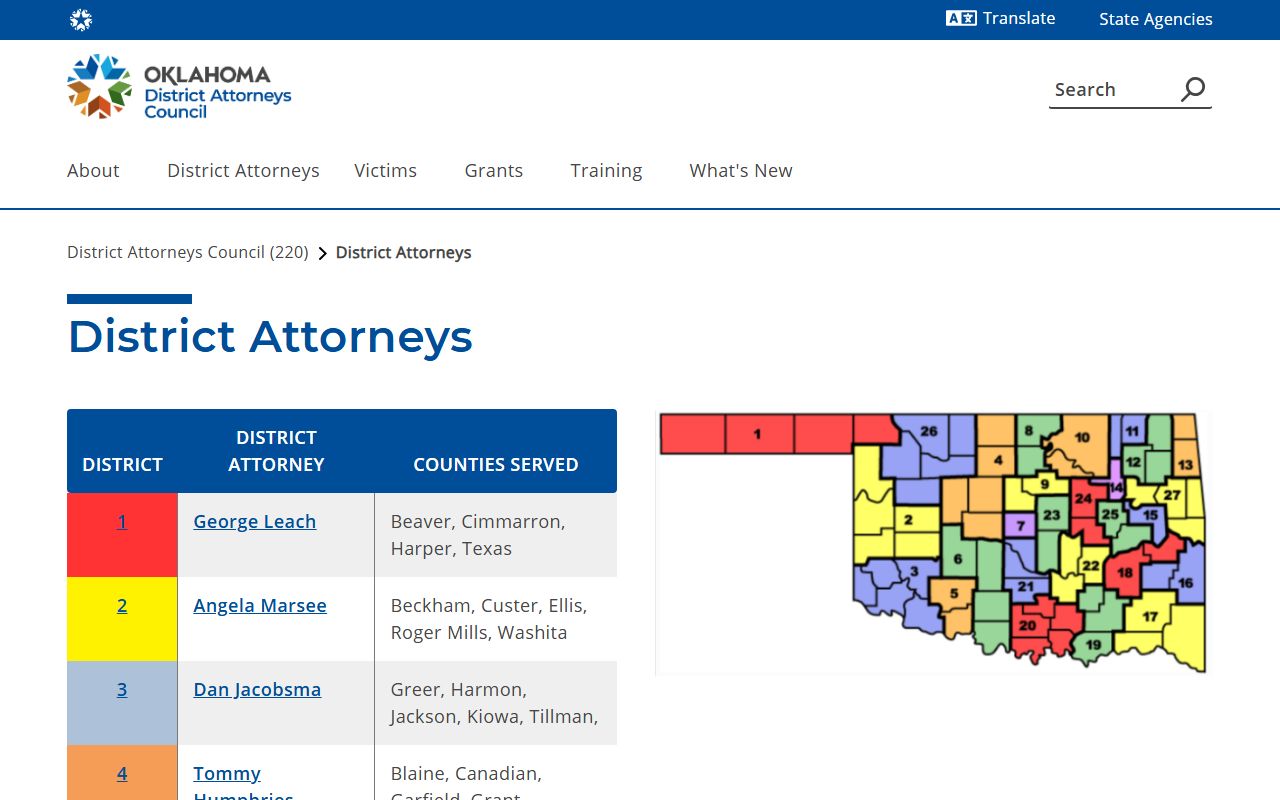
That office is the one that turns an arrest into formal Pushmataha County charges. The document it files sets the count, the statute, and the level that the court record will carry.
| Complaint | Information | Indictment | |
|---|---|---|---|
| Filed By | Officer / Prosecutor | Prosecutor | Grand Jury |
| Common For | Misdemeanors | Many felonies | Serious felonies |
| Starts | The case | The case | The case |
A complaint or an information is the common path for most state cases. An indictment comes from a grand jury and is held for the most serious matters. The same file can carry an arrest warrant or a summons when those are public. Bond terms often show up here as well. A first appearance and an arraignment follow soon after the charge is filed.
Pushmataha County Charge Codes and Severity
Every charge points back to a statute. The code on the case page is shorthand for that law and the level of the offense. Oklahoma sorts crimes into felonies, misdemeanors, and lesser violations. A felony carries the longest possible time and the heaviest fines. A misdemeanor is the lower tier and usually carries jail time of a year or less. One arrest can produce several separate charges. A single incident might list a felony count, a misdemeanor count, and a traffic count on the same case.
Read the level before you judge the case. A high count can be reduced. A low count can be raised. Both can happen before any trial. The code tells you the accusation. It does not tell you the outcome. Count the charges, too. A long list can come from one short event.
Note: A charge code describes the accusation only, so the level can drop or change before the case ever ends.
Charge Status on a Pushmataha County Case
Charges are not fixed once they are filed. As a case moves, counts get added, amended, reduced, dropped, or dismissed. The status on a case page tells you where each count stands today. Reading it correctly keeps you from treating an old accusation as a current one.
| Status | What It Means |
|---|---|
| Pending | The charge is filed and the case is still open, with no final outcome yet. |
| Amended / Reduced | The prosecutor changed the count, often to a lower level or a different statute. |
| Dismissed | The court dropped the charge by motion or order, and it is no longer pursued. |
| Nolle Prosequi | The prosecutor formally declined to pursue the charge, ending it without a conviction. |
Federal Charges in Indian Country
Not every Pushmataha County arrest ends in a state charge. The whole county sits inside the Choctaw Nation Reservation, and the U.S. Attorney's Office calls the Eastern District of Oklahoma entirely Indian country. For certain crimes and certain defendants, charges route to federal court in Muskogee instead of the District Court in Antlers. Those cases follow the federal system and appear on PACER, not on OSCN.
A 2024 Eastern District sentencing announcement out of Antlers shows how a local case can be prosecuted in federal court.
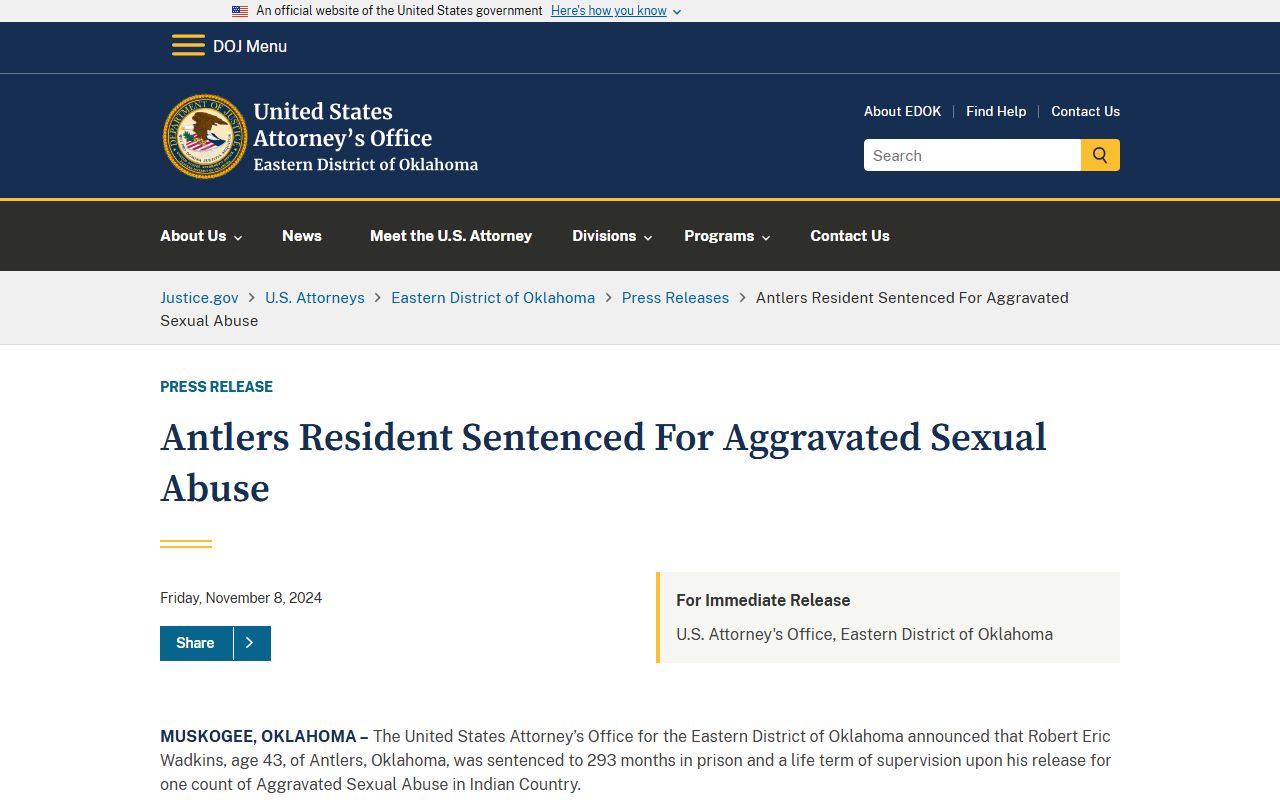
When a charge moves to federal court, the county case search will not hold the file. The federal docket is the place to look instead. State charges still route through the District Court in Antlers when state jurisdiction applies. Most local cases stay there. The federal path is the exception, not the rule.
Charges vs. Convictions
A charge is an accusation. A conviction is the finding that proves it. The gap between the two is the whole point of a criminal case. A person can be charged and never convicted. A public charge record on its own does not show guilt.
| Charge | Conviction | |
|---|---|---|
| Stage | Accusation | Verdict or plea |
| Burden of Proof | Probable cause | Beyond reasonable doubt |
| Public Record | Yes | Yes |
When you read a charge record, check the disposition before you draw a conclusion. A dismissed or amended count means the story changed after the arrest.
Pushmataha County Charges in Statewide Criminal History
County charge records show one court at a time. A statewide criminal history pulls charges and dispositions from across Oklahoma into one report. The Oklahoma State Bureau of Investigation, known as OSBI, runs that system through its online request portal. Several channels exist, and each answers a different question.
- OSCN docket search for charges filed in Pushmataha County District Court, by defendant name or case number.
- District Attorney District 17 case tracking and online payment for District Court balances.
- OSBI criminal history requests: a name-based search costs $15 and a fingerprint-based search costs $19.
- Pushmataha County Sheriff's Office for arrest and booking detail not posted online, reachable through the verified county information line at 580-298-3292.
- Statewide lookups such as the Oklahoma DOC offender search and the sex offender registry for sentenced and registered people.
Under the Oklahoma Open Records Act, 51 O.S. Section 24A.8, law enforcement must release certain basic arrest and booking facts, while open investigations can stay closed. An OSBI report is a rap sheet, not a certified court disposition. Confirm any charge with the Court Clerk before you rely on it.
Sealed vs. Expunged Records
Some charges leave the public view over time. Oklahoma offers two cleanup paths. They are not the same. A sealed record is hidden from public search. An expunged record is treated as though it never existed.
| Sealed | Expunged | |
|---|---|---|
| Visibility | Hidden from public | Treated as if it never existed |
| Law Enforcement | Limited access | Very limited |
| Eligibility | Deferred-sentence path under 22 O.S. Section 991(c) | Arrest-record expungement under 22 O.S. Section 18 |
A Section 991(c) expungement can change the court disposition to show the case was dismissed, but OSBI says it does not erase the arrest record. A full Section 18 expungement can remove the arrest record when the person qualifies. Expunging the court record is free, while the arrest-record step carries a $150 OSBI processing fee and may add local agency costs.
Background Check Considerations
A casual name search is not the same as a regulated background check. Employers, landlords, and licensing bodies rely on these reports. They must follow the Fair Credit Reporting Act when a report drives a decision. For those uses, an OSBI report or an FCRA-compliant screener is the correct source. A quick public lookup is not.
Important: This site is not a consumer reporting agency under the FCRA, and its information cannot be used for employment, tenant, credit, or other FCRA-regulated decisions.
Restricted Pushmataha County Charge Records
Not every charge is open to the public. Some files are closed by law, and others are sealed by court order.
Juvenile charges are not treated like ordinary adult District Court files. Access is usually limited to the parties, their attorneys, named agencies, or a judge's order. Sealed and expunged charges drop out of public search. Open investigations can also stay closed until a charge is filed. When a record does not appear online, the Pushmataha County Court Clerk can confirm whether it exists, is restricted, or was simply never digitized.
Note: A missing charge in the online index does not always mean a clean record, since juvenile, sealed, and pending matters are withheld from public view.